
  • Permits and District Business
  • Valley Water Websites

Home

Main navigation

    • Permits and District Business
    • Valley Water Websites
  • For Residents
    Highlights
    Water Rate Assistance Program
    Find more information to see if you qualify for financial assistance with your water bill.
    Rebates & Surveys
    Programs and rebates helping you save water and money.
    Water Conservation
    Learn the best ways to save water indoors and outdoors.
    Find My Water Retailer
    Find your local retailer who provides water service directly to your home.
    Emergency & Planning
    Flood Emergency Action Plans
    Local Hazard Mitigation Plan
    Get Flood Ready
    Preparation for Extended Power Outages
    Alert System Real Time Data
    Levee Safety
    Save Water & Money
    Rebates & Surveys
    Watersavings.org
    Current Water Charges
    Water Savings Videos
    Indoor Conservation
    Outdoor Conservation
    Projects & Plans
    Projects In Your Neighborhood
    Creek & River Projects
    Dam & Reservoir Projects
    Grants and Environmental Protection
    Infrastructure Improvement Projects
    Safe, Clean Water and Natural Flood Protection Program
    Studies and Reports
    Public Review Documents
    Hydraulic Model Data (HEC)
    Stream Maintenance Program
  • Your Water
    Highlights
    Current Water Charges
    Find the current adopted water charges for private well owners, agricultural and wholesale customers by zone.
    Popular Documents and Data
    Find frequently requested Valley Water documents, reports, and data in one place.
    Water Quality
    Learn how we ensure Santa Clara County has access to safe, clean water.
    Water Supply Master Plan
    Learn how we plan for future water needs and manage supplies during droughts and changing conditions.
    Water Sources
    Groundwater
    Imported Water
    Local Dams and Reservoirs
    Recycled and Purified Water
    Where your water comes from
    Information & Resources
    GIS Data
    Glossary of Water Terms
    District Library
    Popular Documents and Data
    Local Dams and Reservoirs
    Climate Change Action Plan
    Greenhouse Gas Reduction plan
    Water Planning
    Water Supply Master Plan
    Water Supply Planning
    Watershed Master Plan
    Water Treatment
    Water Treatment Plants
    Water Quality
  • Learning Center
    Highlights
    Grants & Partnerships
    Find out how to apply for grants and partner with Valley Water on local water and environmental projects.
    Water Education Programs
    Our program offers assemblies, in-person and virtual lessons and field trips.
    Volunteer & Engage
    Help support our cleanup efforts in Santa Clara County.
    Public Tours
    Discover Valley Water's safe & sustainable water solutions through free public tours.
    Learning & Exploration
    Next Gen Career Pathways Program
    Education Outreach Program
    Water 101 Academy
    Public Tours
    Local Dams and Reservoirs
    Volunteer Engagement
    Volunteer and Engage
    Valley Water Youth Commission
    Adopt a Creek
    Grants & Partnerships
    Public Art
    Environmental Science & Conservation
    Healthy Creeks and Ecosystems
    Watersheds of Santa Clara Valley
    The Water Treatment Process
    Aerial Drone Pilot Program
  • News & Events
    Highlights
    Valley Water News
    Learn more about the latest headlines and announcements from around the district.
    Events
    Find district events happening on variety of topics.
    Videos
    Stay up to date with the latest videos from the district.
    Public Records
    Public Records feature many commonly requested documents and data sets.
    Recent News
    Image
    upstream pope-chaucer from south bank
    August 5, 2026
    Valley Water to continue the public hearing on proposed changes to the Safe, Clean Water and Natural Flood Protection Program

    On August 11, 2026, at 1:00 p.m., the Valley Water Board will continue the public hearing from July 14, 2026, to receive public comment on proposed modifications to two projects within the Safe, Clean Water and Natural Flood Protection Program. 

    You can attend in person at Valley Water headquarters at 5700 Almaden Expressway in San Jose or via Zoom at https://valleywater.zoom.us/j/84454515597

    Read More
    Image
    A look at Sierra Creek after the Stream Maintenance Program work was completed in the summer of 2026.
    A look at Sierra Creek after the Stream Maintenance Program work was completed in the summer of 2026.
    August 4, 2026
    Preparing our creeks for winter: Valley Water's Annual Stream Maintenance Program

    If you've seen Valley Water crews working along local creeks this summer, they're getting some of Santa Clara County's waterways ready for the rainy season. Their work is part of Valley Water's annual Stream Maintenance Program, an effort to reduce the risk of flooding and fire.

    While much of this work happens behind the scenes, it plays a critical role in protecting homes, businesses, schools and other public infrastructure before the rainy season begins.

    Read More
    Image
    A look at the completed floodwall along William Street in San Jose, part of Valley Water’s first phase of flood risk reduction near Coyote Creek.
    A look at the completed floodwall along William Street in San Jose, part of Valley Water’s first phase of flood risk reduction near Coyote Creek.
    August 3, 2026
    Valley Water awards construction contract for the Coyote Creek Flood Protection Project

    Valley Water has taken another major step toward improving flood protection along Coyote Creek. On July 24, 2026, its Board of Directors awarded the construction contract for Phase 2 of the Coyote Creek Flood Protection Project. The project will help reduce flood risk along a nine-mile stretch of the creek between Montague Expressway and Tully Road in San José.

    Read More
  • About Valley Water
    Highlights
    Mission, Vision and Values
    Learn about our core mission, vision for the future, and the values that guide us.
    Board of Directors
    Meet the board members who provide leadership and oversight for Valley Water.
    Finance/Budget
    Access financial information, budgets, and fiscal reports for transparency.
    Committees
    Explore our various committees and their roles in district governance.
    Careers
    Explore our current job openings and benefits.
    Leadership
    Board of Directors
    Board Meetings Agendas & Minutes
    Committees
    Redistricting
    Board Governance Policies
    Accountability
    Public Records
    Lobbyist Ordinance
    Grand Jury Reports
    Enterprise Systems
    Information & Resources
    Finance/Budget
    Capital Improvement Program
    Public Facilities Financing Corporation
    Community Engagement
    Renewed Safe, Clean Water & Natural Flood Protection: Independent Monitoring Committee
    Committees
    Community Partnering Sponsorship Program
  • Services and Support
Loading…
Graywater Rebate

Placing the graywater mulch basins

The most effective graywater “filter” is biologically-active soil covered in mulch! Mulch basins help you avoid removing large particles like hair or lint and help add organic matter back into the soil--organic matter in the soil results in healthier soil and makes it easier for your plants to absorb nutrients. 

What’s a mulch basin?

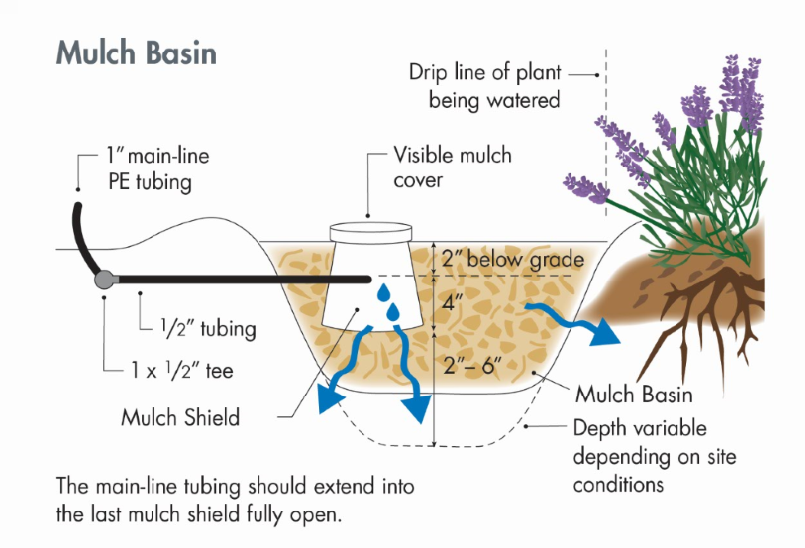
Mulch basins catch large particles in mulch, help transform the mulch into compost over time, and help the graywater soak down into the soil to irrigate plant roots. A mulch basin is a trench dug around the outer edge of a plant's drip line and back-filled with mulch. A plant's "drip line" is an imaginary line drawn from the outside branches of a plant down to the soil (see inset image). 

  • Mulch basins can be any shape. They are typically as wide as a shovel. They should be as flat as possible to help graywater flow evenly.

  • The graywater pipe is protected in a "mulch shield", separated from the surface above and more mulch below. This setup allows graywater to spread widely and deeply into your soil while preventing runoff or ponding of graywater. 

  • Maintenance typically includes checking the ends of the graywater pipe for obstructions to remove and replacing the mulch as it composts over time (once a year in general). Coarser mulch will last much longer than finer mulch and will be better at filtering out any large debris from the graywater.


How do you size a mulch basin?

The amount of area you need to contain mulch basins is determined by how much graywater you produce and your soil type to prevent pooling, ponding, or runoff of graywater. Healthier soils will reduce the size of mulch basins while making it easier for your landscape to benefit even more from graywater. When you apply for the rebate, Valley Water will provide you the total square footage you’ll need based on how much laundry you do and the type of soil in your landscape.

How do you install a mulch basin?

Avoid shallow utilities (water, gas, electric) or septic systems by calling the Underground Service Alert at (800) 227-2600 or 811 before you dig.

  • To install a mulch basin, locate the outer edge of the canopy on each plant -- its drip line. If it’s a younger plant, imagine where its outer edge may be in a year or two. Too far out and the plant won’t benefit as much from the graywater; too close in and you may damage the plant’s roots when digging.
  • Immediately outside of the drip line, begin creating a 6-18 inch wide and 6-12 inch-deep trench with a shovel. The mulch basin shall be deep enough so that the graywater pipe is 2-inches below the soil surface within a mulch shield, and the mulch shield rests on a 2-inch cushion of mulch within the mulch basin. The top of the mulch shield will be visible from the basin.
  • A valve box can be used as mulch shields. These can be purchased at a hardware store, a home improvement store, or from a landscape supply store. Some garden centers and nurseries sell them as well. Larger, round valve boxes provide more space to place and adjust the piping as you finalize your system.

To avoid mistakes, dry-fit your piping and test how the graywater flows. It’ll be much easier to adjust your piping and mulch basins, and tighten loose connections when everything is still unglued and exposed.

Footer Top

  • Valley Water Logo
  • Report an Issue
  • Contact Us
  • Services & Support
  • Join our Newsletter
  • Valley Water Logo
  • Join our Newsletter
  • Report an Issue
  • Contact Us
  • Services & Support

Footer

  • For Residents
    • Water Charges
    • Grants and Rebates
    • Water Conservation
    • Projects and Plans
    • Outdoor Survey
    • Watersavings.org
    • Water Quality
    • Water Supply Planning
  • In an Emergency
    • Get Flood Ready
    • Levee Safety
    • Dam Safety Program
    • Flood Emergency Action Plan
    • Local Hazard Mitigation Area
    • Climate Change Action Plan
  • Data & Resources
    • GIS Data
    • Popular Documents
    • HEC-2 Data Library
    • Surface Water Data Portal
    • Water Sensor ALERT
    • Find My Water Retailer
  • About Valley Water
    • Finance & Budget
    • Board of Directors
    • Board Meetings & Agendas
    • Committees
    • Board Governance Policies
    • Careers
  • In the District
    • Permits
    • Report a Problem
    • Contact Us
    • Purchasing and Contracts
    • Construction Administration
    • Business Resources
  • Learning Center
    • Water Education Programs
    • Water 101 Academy
    • Public Tours
    • Adopt a Creek
Santa Clara Valley Water District 2026
Pollution Hotline 888-510-5151
Phone: 408-265-2600