
  • Permits and District Business
  • Valley Water Websites

Home

Main navigation

    • Permits and District Business
    • Valley Water Websites
  • For Residents
    Highlights
    Water Rate Assistance Program
    Find more information to see if you qualify for financial assistance with your water bill.
    Rebates & Surveys
    Programs and rebates helping you save water and money.
    Water Conservation
    Learn the best ways to save water indoors and outdoors.
    Find My Water Retailer
    Find your local retailer who provides water service directly to your home.
    Emergency & Planning
    Flood Emergency Action Plans
    Local Hazard Mitigation Plan
    Get Flood Ready
    Preparation for Extended Power Outages
    Alert System Real Time Data
    Levee Safety
    Save Water & Money
    Rebates & Surveys
    Watersavings.org
    Current Water Charges
    Water Savings Videos
    Indoor Conservation
    Outdoor Conservation
    Projects & Plans
    Projects In Your Neighborhood
    Creek & River Projects
    Dam & Reservoir Projects
    Grants and Environmental Protection
    Infrastructure Improvement Projects
    Climate Change Action Plan
    Safe, Clean Water and Natural Flood Protection Program
    Studies and Reports
    Public Review Documents
    Hydraulic Model Data (HEC)
    Stream Maintenance Program
  • Your Water
    Highlights
    Current Water Charges
    Find the current adopted water charges for private well owners, agricultural and wholesale customers by zone.
    Popular Documents and Data
    Find frequently requested Valley Water documents, reports, and data in one place.
    Water Quality
    Learn how we ensure Santa Clara County has access to safe, clean water.
    Water Supply Master Plan
    Learn how we plan for future water needs and manage supplies during droughts and changing conditions.
    Water Sources
    Groundwater
    Imported Water
    Local Dams and Reservoirs
    Recycled and Purified Water
    Where your water comes from
    Information & Resources
    GIS Data
    Glossary of Water Terms
    District Library
    Popular Documents and Data
    Local Dams and Reservoirs
    Water Planning
    Water Supply Master Plan
    Water Supply Planning
    Water Treatment
    Water Treatment Plants
    Water Quality
  • Learning Center
    Highlights
    Grants & Partnerships
    Find out how to apply for grants and partner with Valley Water on local water and environmental projects.
    Water Education Programs
    Our program offers assemblies, in-person and virtual lessons and field trips.
    Volunteer & Engage
    Help support our cleanup efforts in Santa Clara County.
    Public Tours
    Discover Valley Water's safe & sustainable water solutions through free public tours.
    Learning & Exploration
    Next Gen Career Pathways Program
    Water Education programs and Events
    Water 101 Academy
    Public Tours
    Local Dams and Reservoirs
    Volunteer Engagement
    Volunteer and Engage
    Valley Water Youth Commission
    Adopt a Creek
    Grants & Partnerships
    Public Art
    Environmental Science & Conservation
    Healthy Creeks and Ecosystems
    Watersheds of Santa Clara Valley
    The Water Treatment Process
    Aerial Drone Pilot Program
  • News & Events
    Highlights
    Valley Water News
    Learn more about the latest headlines and announcements from around the district.
    Events
    Find district events happening on variety of topics.
    Videos
    Stay up to date with the latest videos from the district.
    Public Records
    Public Records feature many commonly requested documents and data sets.
    Recent News
    Image
    The tide gate structure has been seismically retrofitted and rehabilitated, featuring deeper foundations to withstand extreme seismic events, new barrier fencing, and a newly resurfaced top.
    The tide gate structure has been seismically retrofitted and rehabilitated, featuring deeper foundations to withstand extreme seismic events, new barrier fencing, and a newly resurfaced top.
    May 5, 2026
    Palo Alto Tide Gate Project Reaches Key Milestone

    Valley Water has reached a major milestone in extending the life of an important flood protection system in Palo Alto. In February 2026, the agency completed Phase 1 of the Palo Alto Flood Basin Tide Gate Structure Seismic Retrofit and Rehabilitation Project. 

    Read More
    Image
    A home with a wooden deck and balcony is surrounded by a vibrant, drought-tolerant garden filled with colorful flowers like orange poppies, purple blooms, and green shrubs, with a stone pathway leading to the front door and a large tree in the yard.
    April 28, 2026
    Bring Your Dream Yard to Life This Spring!

    Spring is here, and it’s the perfect time to refresh your outdoor space. Imagine stepping outside to a yard that’s not only beautiful but also sustainable, a space filled with vibrant plants, smart irrigation, and features that save water and money. With Valley Water’s rebate programs, that dream yard is closer than you think!

    Read More
    Image
    A view of the tunnel entrance on the right, and the diversion outlet structure. The staged, 13-foot diameter pipe will be placed inside the tunnel and will connect to the diversion outlet structure. April 2026.
    A view of the tunnel entrance on the right, and the diversion outlet structure. The staged, 13-foot diameter pipe will be placed inside the tunnel and will connect to the diversion outlet structure. April 2026.
    April 27, 2026
    Anderson Dam Tunnel Project on track for completion in 2026

    The Anderson Dam Tunnel Project is entering its final stages, with Valley Water contractors completing key milestones such as the final concrete work inside the tunnel and installation of critical components. The project remains on track for completion in 2026.

    Read More
  • About Valley Water
    Highlights
    Mission, Vision and Values
    Learn about our core mission, vision for the future, and the values that guide us.
    Board of Directors
    Meet the board members who provide leadership and oversight for Valley Water.
    Finance/Budget
    Access financial information, budgets, and fiscal reports for transparency.
    Committees
    Explore our various committees and their roles in district governance.
    Careers
    Explore our current job openings and benefits.
    Leadership
    Board of Directors
    Board Meetings Agendas & Minutes
    Committees
    Redistricting
    Board Governance Policies
    Accountability
    Public Records
    Lobbyist Ordinance
    Grand Jury Reports
    Enterprise Systems
    Information & Resources
    Finance/Budget
    Capital Improvement Program
    Public Facilities Financing Corporation
    Community Engagement
    Renewed Safe, Clean Water & Natural Flood Protection: Independent Monitoring Committee
    Committees
    Community Partnering Sponsorship Program
  • Services and Support
Loading…
  • Water Quality Reports
  • Taste and Odor Facts
  • How we clean your water
    • Water Treatment Plants
  • Protecting Your Water
    • PFAS
    • Fluoridation
    • Algal Toxins/Cyanotoxins
    • Trihalomethanes (THMs)
    • Lead
    • Invasive Mussels
  • Reopening buildings following an extended shutdown

Breadcrumb

  1. Home
  2. Your Water
  3. Water Quality
  4. Protecting Your Water
  5. Algal Toxins/Cyanotoxins FAQ

Algal Toxins/Cyanotoxins FAQ

Content

Downloadable FAQ [PDF]
 

1. WHAT ARE HARMFUL ALGAL BLOOMS AND CYANOTOXINS?

Cyanobacteria, or blue-green algae, are found naturally in lakes, rivers, ponds, and other surface waters.  Under certain conditions, such as in warm water containing an abundance of nutrients, they can rapidly form harmful algal blooms (HABs). HABs may have negative impacts on ecosystems, and human and animal health. Some HABs are capable of producing toxins, called algal toxins or cyanotoxins, which can be harmful to humans and animals. [1]


2. HOW CAN HUMANS AND PETS BE EXPOSED TO CYANOTOXINS?

Human exposure to cyanotoxins generally occurs through ingestion or skin contact during recreational water activities (e.g. swimming and wading) when cyanotoxins are present, or by consuming drinking water or food (e.g. fish and shellfish) containing cyanotoxins. [2][3] 

Pets may be exposed to cyanotoxins if they drink water that has cyanotoxins, lick their fur after swimming in contaminated water with cyanotoxins, or eat algal scum or mats containing cyanotoxins. [2]


3. WHAT ARE POTENTIAL HEALTH EFFECTS FROM CYANOTOXINS TO HUMANS AND PETS?

In humans, potential health effects include upset stomach, fever, headaches, muscle and joint pain, vomiting and diarrhea, liver and kidney damage, and skin and eye irritation. [1][2][3]  

In pets, health effects from cyanotoxins may include skin rashes, vomiting, diarrhea, seizures, and even death. [2]  


4. ARE THERE DRINKING WATER STANDARDS FOR CYANOTOXINS?

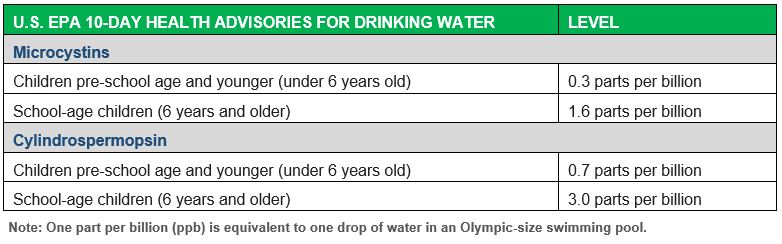
Currently, there are no drinking water regulations for cyanotoxins. However, in 2015, the U.S. Environmental Protection Agency (EPA) issued 10-Day Health Advisories for the cyanotoxins microcystins and cylindrospermopsin (see Table below). Per the U.S. EPA, consuming drinking water that has cyanotoxins at or below the advisory levels for 10 days or less is not expected to cause adverse health effect to humans. 
 

Image
EPA 100-day health advisories

5. ARE THERE REGULATIONS FOR CYANOTOXINS IN RECREATIONAL WATERS?

Currently, there are no state or federal regulations for cyanotoxins in recreational waters. However, there are U.S. EPA Health Advisories which are summarized in Table below. [4]

Image
EPA health advisories for recreational waters

6. HAVE CYANOTOXINS EVER BEEN DETECTED IN VALLEY WATER’S TREATED DRINKING WATER?

Valley Water has a comprehensive algal toxin monitoring and response program. We routinely monitor cyanotoxins in Valley Water’s drinking water delivered from our three surface water treatment plants.  Since initiating the cyanotoxins monitoring program in 2015, there have been no detection of cyanotoxins in Valley Water’s treated drinking water.


7. HAVE CYANOTOXINS EVER BEEN DETECTED IN THE SOURCE WATER SUPPLYING VALLEY WATER’S TREATMENT PLANTS?

Cyanotoxins are detected routinely in reservoirs, mainly near the shoreline or boat launch areas. Drinking water source intakes are typically located in the deepest part of the reservoirs, well below the surface and far from the shoreline. As a result, very low levels of cyanotoxins have occasionally been detected in the source water supplying Valley Water’s treatment plants. At these plants, the water is treated to meet State and Federal drinking water standards before it is delivered to local water retailers. Cyanotoxins have never been detected in the water delivered by Valley Water. 


8. WHAT WILL VALLEY WATER DO IF IT FINDS CYANOTOXINS IN ITS TREATED DRINKING WATER?

If cyanotoxins were detected in treated drinking water, Valley Water would immediately notify the state regulatory agency for drinking water (State Water Resources Control Board’s Division of Drinking Water), the Santa Clara County Department of Environmental Health, and affected water retailers. Valley Water would also explore operational changes to reduce the level of cyanotoxins such as changing the water source supplying our water treatment plants or adjusting treatment processes.


9. DOES VALLEY WATER MONITOR CYANOTOXINS IN VALLEY WATER’S RESERVOIRS AND PONDS?

While recreational activities such as boating are allowed in some of Valley Water’s reservoirs, swimming and/or wading is prohibited in all Valley Water’s reservoirs and percolation ponds. This restriction applies to both people and pets. As such, Valley Water currently does not routinely monitor for cyanotoxins in its reservoirs and percolation ponds. Valley Water has a seasonal algae control program for percolation ponds that includes application of a harmless dye, an enzyme treatment, and/or algae harvesting. All recreational activities at Valley Water’s reservoirs are managed by the Santa Clara County Parks and Recreation Department [5], and the two agencies are working together on posting informational signage regarding algal blooms at Valley Water’s reservoirs.


10. WHERE CAN I FIND MORE INFORMATION ABOUT HARMFUL ALGAL BLOOMS AND CYANOTOXINS?

  • U.S. EPA: Cyanotoxin
  • U.S. EPA: Harmful Algal Blooms
  • State Water Resources Control Board’s Division of Drinking Water: Cyanotoxin
  • U.S. EPA Informational Signage on Harmful Algal Blooms


What We Do
Valley Water manages an integrated water resources system that includes the supply of clean, safe water, flood protection and stewardship of streams on behalf of Santa Clara County’s 2 million residents. We effectively manage 10 dams and surface water reservoirs, three drinking water treatment plants, an advanced recycled water purification center, a state-of-the-art water quality laboratory, nearly 400 acres of groundwater recharge ponds and more than 275 miles of streams.

We provide wholesale water and groundwater management services to local municipalities and private water retailers who deliver drinking water directly to homes and businesses in Santa Clara County.

---------------------------------------------------------------------------------------------------------------------------------------

FOOTNOTES

[1] https://www.epa.gov/sites/production/files/2016-11/documents/harmful_algal_blooms_and_cyanotoxins_frequently_asked_questions.pdf

[2] https://www.epa.gov/sites/production/files/2016-12/documents/draft-hh-rec-ambient-water-swimming-factsheet.pdf

[3] https://www.epa.gov/sites/production/files/2015-07/documents/habs_faqs-and-resources_v1-july2015.pdf

[4] https://www.epa.gov/sites/production/files/2019-05/documents/hh-rec-criteria-habs-factsheet-2019.pdf

[5] https://www.sccgov.org/sites/parks

Footer Top

  • Valley Water Logo
  • Report an Issue
  • Contact Us
  • Services & Support
  • Join our Newsletter
  • Valley Water Logo
  • Join our Newsletter
  • Report an Issue
  • Contact Us
  • Services & Support

Footer

  • For Residents
    • Water Charges
    • Grants and Rebates
    • Water Conservation
    • Projects and Plans
    • Outdoor Survey
    • Watersavings.org
    • Water Quality
    • Water Supply Planning
  • In an Emergency
    • Get Flood Ready
    • Levee Safety
    • Dam Safety Program
    • Flood Emergency Action Plan
    • Local Hazard Mitigation Area
    • Climate Change Action Plan
  • Data & Resources
    • GIS Data
    • Popular Documents
    • HEC-2 Data Library
    • Surface Water Data Portal
    • Water Sensor ALERT
    • Find My Water Retailer
  • About Valley Water
    • Finance & Budget
    • Board of Directors
    • Board Meetings & Agendas
    • Committees
    • Board Governance Policies
    • Careers
    • Internships
  • In the District
    • Permits
    • Report a Problem
    • Contact Us
    • Purchasing and Contracts
    • Construction Administration
    • Business Resources
  • Learning Center
    • Water 101 Academy
    • Public Tours
    • Adopt a Creek
Santa Clara Valley Water District 2026
Pollution Hotline 888-510-5151
Phone: 408-265-2600