


Chances are, you are using more water in your home or business than you need to. Valley Water offers free water conservation devices, as well as resources to help you select efficient appliances and tips for saving water every day. We also offer free resources for businesses and commercial facilities.
Free water conservation devices
We offer free devices and literature to help you learn to save more water and more information on this page.
Showerheads
According to EPA WaterSense, showering uses almost 1/5th of all water used in your home.
The standard showerhead uses 2.5 gallons per minute. By upgrading to a WaterSense labeled showerhead that uses no more than 2.0 gallons per minute, your family will save thousands of gallons a year. Using a 5-minute shower timer will save even more.
- To receive a free shower timer or a free showerhead, order from our shopping cart. If you're not sure how efficient your showerhead is, check out our simple DIY Water Wise Indoor Survey.
- Watch an instructional video on how to replace your showerhead.
Faucet Aerators
Bathroom and kitchen aerators are screens that cover the faucet opening where water comes out. Faucet aerators can use 2.5 gallons per minute (GPM) or as little as 0.5 GPM.
Upgrading your faucets can save 1.2 gallons per person per day, saving thousands of gallons per year while maintaining the same performance. According to WaterSense, an average family can save $250 in water and electricity costs over a faucet’s lifetime by upgrading an old, inefficient aerator.
- To receive this equipment for free, order from our shopping cart. If you're not sure how efficient your faucets are, check out our simple DIY Water Wise Indoor Survey.
- Watch an instructional video on how to replace your faucet aerators.
Water Saving Devices
Leaking toilets will waste thousands of gallons, potentially causing a drastic spike in your regular monthly bill. Leaking toilets may be silent until you open your water bill. We offer toilet flappers for free that can help resolve some types of toilet leaks.
- To receive free toilet flappers, order from our shopping cart. If you're not sure how efficient your showerhead is, check out our simple DIY Water Wise Indoor Survey.
- Watch an instructional video on how to replace a leaky toilet flapper.

Find efficient appliances
Find tips and resources to save water, energy and money for appliances such as clothes washers, dishwashers, and toilets.
Clothes Washer Information
Does Valley Water offer high-efficiency clothes washer rebates?
No. However, upgrading your clothes washer to a more efficient version can save you money, water and energy. A 10-year-old standard clothes washer costs you on average $185 more per year in water and energy costs than a new, high-efficiency clothes washer.
What are the most efficient clothes washers on the market?

Check out Energy Star's Most Efficient Clothes Washers List for specific brands, models, cost estimates, and features of the most efficient washers on the market.
What do I look for when buying a new clothes washer?
The Energy Star label indicates a clothes washer has been independently certified to save energy and water. Find more clothes washer shopping tips.
Once you know what you need, you can use the Energy Star Product Finder to help you find clothes washers that meet your criteria and preferences.
What are some best practices to conserve water and energy when using a clothes washer?
Energystar.gov provides many easy tips to adopt in your laundry habits to save water, energy and money.
Dishwasher Information
Does Valley Water offer high-efficiency dishwasher rebates?
No. However, upgrading your dishwasher with a more efficient version can save you money, water, and energy. According to Energy Star, washing dishes in a new Energy Star dishwasher rather than hand washing can save up to $40 per year.
What are the most efficient dishwashers on the market?
Check out Energy Star's Most Efficient Dishwashers List for specific brands, models, cost estimates, and features of the most efficient dishwashers on the market.
What should you look for when buying a new dishwasher?
The Energy Star label indicates a dishwasher has been independently certified to save energy and water. Find shopping tips.
The Energy Star Product Finder will help you find dishwashers that meet your criteria and preferences.
Toilet Information
Eliminate much of the guesswork when upgrading to a high-efficiency toilet. We can help you understand:
- What to measure before you chose an efficient toilet
- The criteria to look for when upgrading your toilet
- How to properly dispose of your old toilet.
Why should you consider upgrading to a high-efficiency toilet?
Toilets are by far the main source of water use in the home, accounting for nearly 30% of an average home’s indoor water use. WaterSense labeled toilets are independently certified to meet rigorous criteria for both performance and efficiency.
What do I need to know before I purchase an efficient toilet?
Review the 15 important tips for upgrading your toilets (PDF). Commercial facilities will have additional considerations.
What are the most efficient toilets on the market?
Premium high-efficiency toilets (HETs) flush effectively with 1.1 gallons per flush or less and can be found at select retailers [XLSX], as well as other retailers since this list was created, and online.
- View this list of the most efficient toilets available for residential use [PDF]. It can also be downloaded as an Excel file [XLSX].
- This list highlights the most efficient commercial toilets [PDF] (flushometer valve/bowl combinations). It can also be downloaded as an Excel file [XLSX].

What do I look for when buying a new toilet?
The WaterSense label identifies water-efficient products that have been independently certified to meet WaterSense criteria for efficiency and performance.
Do high-efficiency toilets require double-flushing?
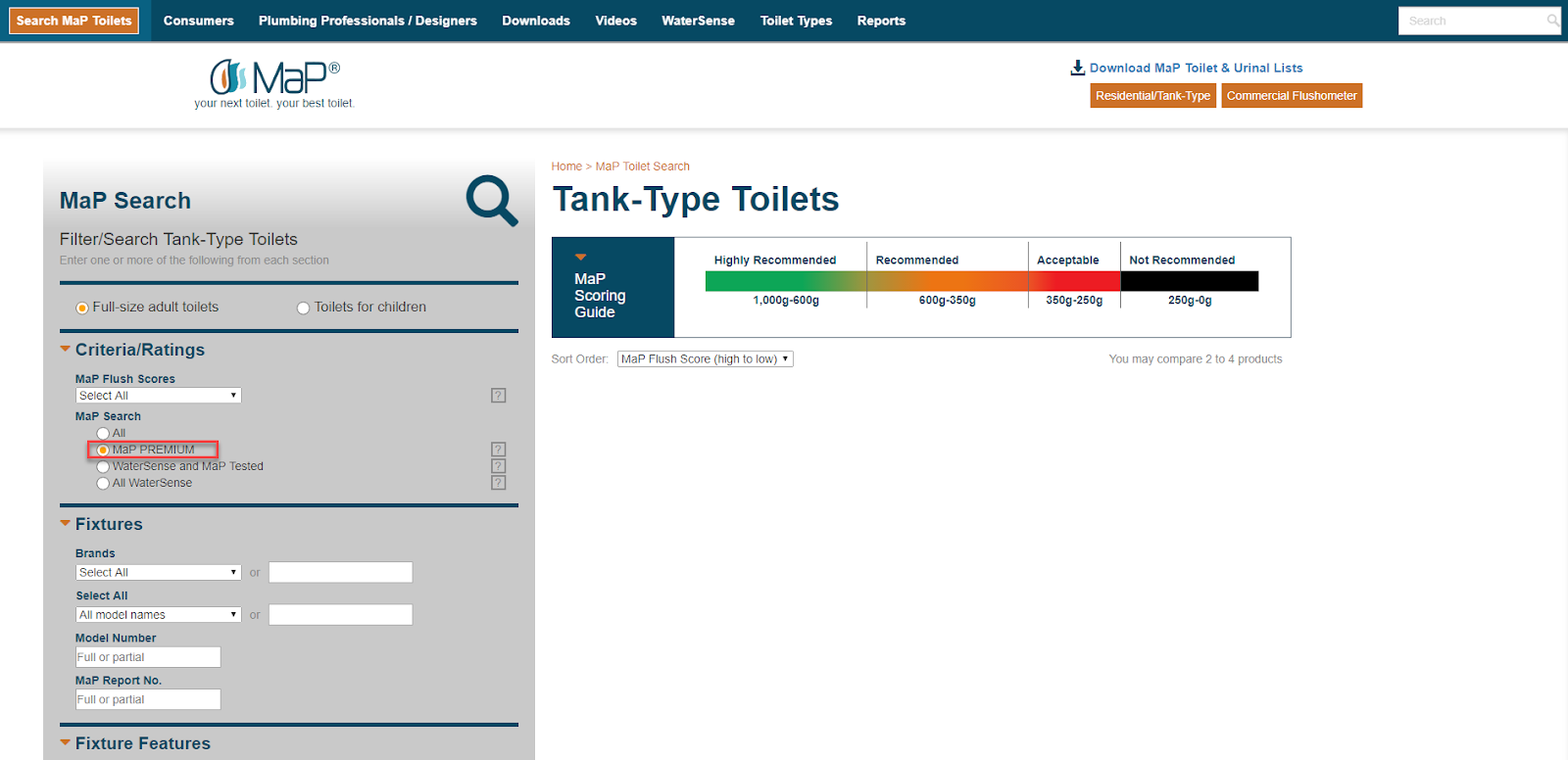
High-efficiency toilets flush just as well or better than conventional toilets. To find the most efficient toilets, search on the MaP Testing website by selecting “MaP PREMIUM Rated” toilets in the Criteria/Ratings search filters. You can further search and filter based on other features you may need.
Maximum Performance provides additional resources and assistance to help you enter the criteria and features that YOU are looking for in a new toilet before going to the store.
How and where can I dispose of my old toilet?
Find a local disposal site that accepts old toilets for recycling or disposal. Call ahead to confirm hours and disposal fees.
Water Heater Information
According to EnergyStar, water heating is the second largest energy use in the home. Choosing an efficient water heating system can reduce energy consumption as well as impact your indoor water use by cutting down on the time you wait for hot water to reach your faucets and showers. Whether building a new home or business; or retrofitting your property, you may want to consider upgrading from a standard electric storage tank water heating system to save water, energy, and money.

What is a heat pump water heater (HPWH)?
HPWHs work by extracting heat from the air surrounding the unit, increasing heat further with compression, delivering the heat to the water and exhausting the remaining cool air back out to the area surrounding the unit. HPWHs can use less than half the energy that standard electric heaters do.
What is a tankless water heater?
A tankless water heater provides on demand hot water without the use of a storage tank. Cold water is sent to the heating unit and is released as hot water through your faucet. Tankless water heaters can be heated with natural gas or with an electric coil. Since there is no need to heat an entire water tank, they can deliver a continuous supply of hot water when needed.
What is a Point of Use (POU) Water Heater?
POU water heaters work to reduce heat loss that generally occurs in a centralized water heating system. POU devices are installed at a distance from the central water heater, near a fixture or appliance where additional heat is needed. They are usually small enough to fit in a cabinet or closet and provide a source of hot water close to the distant fixtures, creating a decentralized heating system. POUs can be beneficial for additions with remote bathrooms, or hot tubs.
What is a hot water recirculating system?
A hot water recirculating system delivers hot water on demand to reduce wait time and waste while the water running from your faucet or shower is being heated. A recirculating pump sends cold water that is in the hot water line back to the water heater, instead of allowing it to run through the faucet and down the drain. At the same time, the system fills the hot water line with hot water from the heater. When hot water reaches the system, the zone valve closes, and the pump shuts off automatically. Demand hot water recirculation systems can be activated by a thermostat, timer, switch, or run continuously. In switch systems, the user manually recirculates the water before use to ensure the lowest amount of energy and water waste. In a continuous system, the recirculating device is constantly pumping, always ensuring hot water, but also using significant energy. Pumps are typically installed at the water fixture located farthest from the water heater to allow for full recirculation in the system.
How do I determine which hot water system is best for my property?
Learn more at Energy Star and the Department of Energy. The Energy Saver 101: Water Heating infographic shows a visual comparison of costs and benefits to assist you in choosing your efficient water heating system.
Does Valley Water offer a rebate for water heating systems?
No. However hot water recirculating systems can be installed for a relatively low cost of $200-300. Read Valley Water’s Hot Water Recirculation Pilot Study to learn about the potential water savings associated with these systems.
The initial cost of installing a tankless water heater or heat pump water heater is higher than a traditional water heater. However, in the long run, generating hot water on demand can save water, energy, and money. You may be able to receive a federal tax credit for installing an Energy Star certified water heating system. Visit Energy Star Rebate Finder to see if you qualify.
Commercial, industrial and multi-family appliances
Request free water saving materials, and learn about rebates for commercial and multi-family properties.
Free devices and signage
To businesses, facilities and other commercial facilities we offer the follow items for free. Valley Water is currently working on developing the Shopping Cart to include a customer portal for commercial agencies. Until that update is released, please email Cindy Torres at [email protected] to request any commercial items or normal items in bulk quantities for specific sites.
- Table Tents for Restaurants “Drinking Water By Request”
- Hotel “Linen Reuse” Cards
- High-Efficiency Faucet Aerators – 0.5 gallons per minute
- Pre-Rinse Sprayers – 1.15 gallons per minute
Commercial facility upgrade rebate
Valley Water offers rebates through the Water Efficient Technology (WET) Rebate Program to help implement equipment changes that reduces commercial or facility water usage. The rebate is available to commercial, industrial and institutional water customers. Find additional resources and tips to help your facility make cost-effective and sustainable upgrades.
Multi-family submeter rebate
Valley Water offers $150 rebates* for installing qualifying water submeters at multi-family complexes like mobile home parks, apartments or HOAs through the Submeter Rebate Program.
*More in cost-sharing areas
Conserving water outside your home
Learn about high-efficiency irrigation equipment to help minimize water use in your landscape.
Questions or request equipment
Call the Water Conservation Hotline at (408) 630-2554 or email us at [email protected].